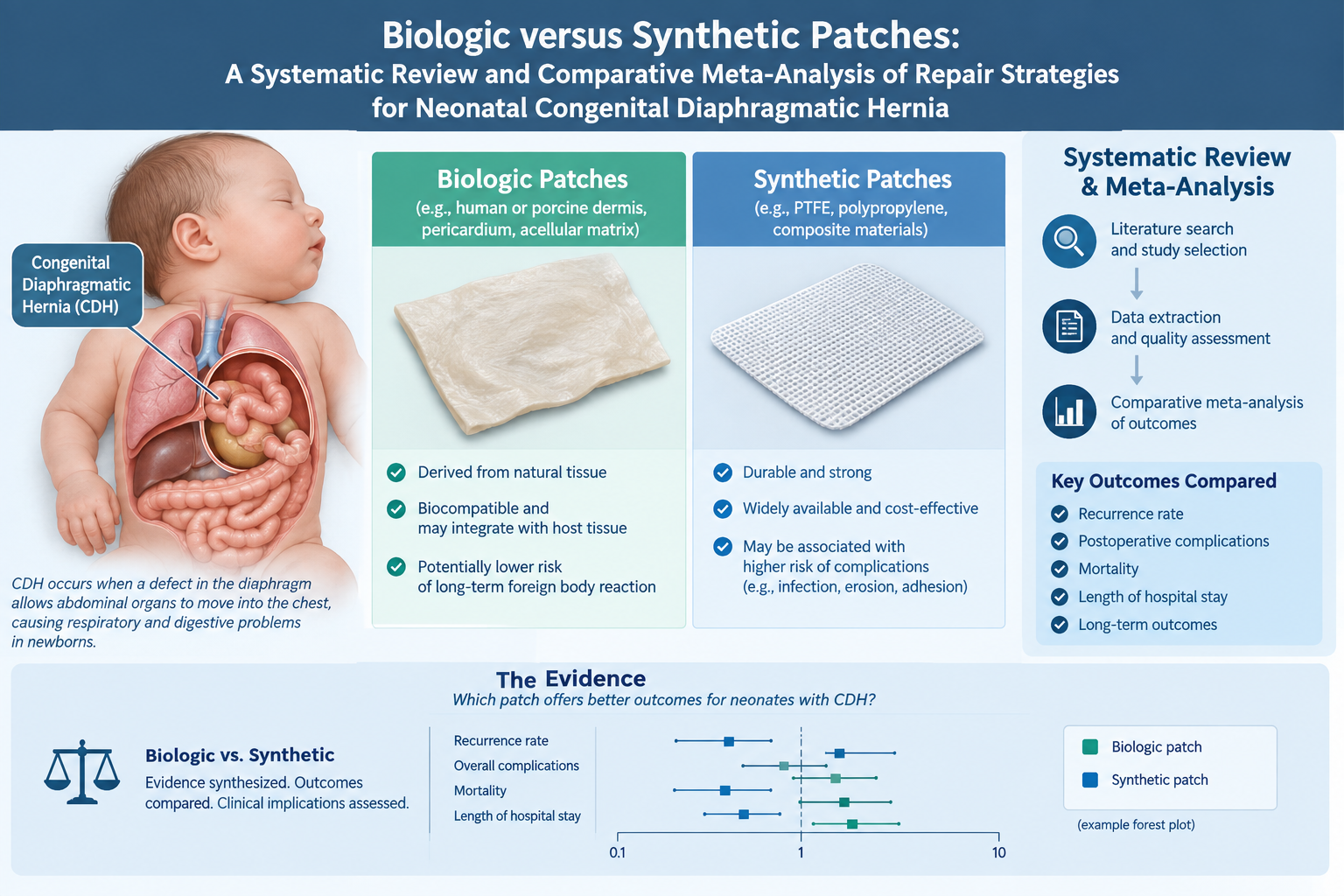
Understanding Congenital Diaphragmatic Hernia
Congenital Diaphragmatic Hernia (CDH) is one of the more serious birth defects a newborn can face. It occurs when the diaphragm — the muscle that separates the chest from the abdomen — fails to form completely during fetal development. This leaves an opening through which abdominal organs, including the intestines, stomach, and sometimes the liver, can move upward into the chest cavity.
The consequences of this displacement can be significant. As abdominal organs occupy space meant for the lungs, normal lung development is disrupted, often resulting in pulmonary hypoplasia (underdeveloped lungs) and pulmonary hypertension (high blood pressure in the lung's blood vessels). Despite major advances in prenatal diagnosis, neonatal intensive care, and surgical technique over the past few decades, CDH continues to carry considerable risk, particularly in babies born with large diaphragmatic defects that cannot be closed with a simple suture repair.
Why Patch Repair Is Needed
When a defect is too large for the native diaphragmatic tissue to be pulled together and sutured directly, surgeons turn to patch repair. A patch essentially bridges the gap in the diaphragm, giving it structural integrity while the surrounding tissue heals. Two broad categories of patch material are used in clinical practice today:
- Synthetic patches, most commonly expanded polytetrafluoroethylene (ePTFE, widely known by the brand name Gore-Tex), along with materials like polypropylene. These are valued for their mechanical strength and predictable durability.
- Biologic patches, derived from human or animal tissue — including acellular dermal matrices (such as AlloDerm, DermaMatrix, and Permacol) and small intestinal submucosa products (such as Surgisis). These are designed to act as scaffolds that encourage the baby's own tissue to grow into and remodel the patch over time.
Each type of patch comes with its own theoretical trade-offs. Synthetic materials are strong and widely available but have historically been linked to a higher likelihood of infection, seroma (fluid collection), and poor long-term tissue integration, since the body treats them as a permanent foreign material. Biologic patches, on the other hand, are thought to integrate more naturally with the body's own tissue, which may lower infection risk — but questions have persisted about whether they hold up as well over time, particularly regarding the risk of the hernia recurring.
What This Research Set Out to Do
Given how contested this decision remains among pediatric surgeons, a team of researchers conducted a systematic review and meta-analysis to bring together the best available evidence comparing biologic and synthetic patches in neonatal CDH repair. Following PRISMA guidelines, they searched the PubMed and Scopus databases for all relevant observational studies published through May 2025, supplementing this with a manual review of reference lists from related articles.
To be included, a study had to involve neonates who underwent CDH repair, directly compare biologic versus synthetic patch outcomes, and report at least one outcome of interest. After screening more than 2,800 initial records and reviewing 113 full-text articles in detail, 17 studies met all inclusion criteria — together representing 608 neonates. Of these babies, 249 (about 41%) had undergone repair with a biologic patch, while 359 (about 59%) had received a synthetic patch. The studies included were published between 2006 and 2021, with individual cohort sizes ranging from as few as 5 to as many as 72 patients.
The primary outcome the researchers focused on was hernia recurrence — essentially, whether the diaphragmatic defect reopened after the initial repair. Several secondary outcomes were also examined: small bowel obstruction, mortality, the need for extracorporeal membrane oxygenation (ECMO), length of hospital stay, and duration of mechanical ventilation.
What the Data Showed
After pooling the results using a random-effects statistical model, the researchers found that none of the outcomes examined differed significantly between biologic and synthetic patches:
- Hernia recurrence: The crude recurrence rate was numerically higher in the biologic patch group (34.7%) than in the synthetic group (20.1%), and the pooled estimate hinted at a trend toward more recurrence with biologic patches. However, this difference stopped just short of statistical significance, meaning it could plausibly be due to chance given the available data.
- Small bowel obstruction: Occurred in roughly 21% of biologic patch cases versus 9% of synthetic patch cases in the pooled data, but again, this gap was not statistically significant.
- Mortality: Death rates were similar between the two groups (20% biologic versus 16% synthetic), with very low variation across studies, making this one of the more consistent findings in the analysis.
- ECMO requirement: Almost identical between groups (around 29% in both), suggesting that the need for this intensive life-support intervention is driven by factors other than patch material.
- Length of hospital stay and ventilation duration: Both showed wide variability across studies but no clear or consistent advantage for either patch type.
The researchers also assessed how much individual studies were skewing these pooled results, and ran sensitivity analyses by excluding each study one at a time. Broadly, the overall conclusions held steady even when individual studies were removed — though a handful of specific studies had a noticeably larger pull on certain outcomes, particularly for small bowel obstruction and ECMO use.
Reading Between the Lines
Perhaps the most clinically useful message from this analysis isn't a specific number — it's the absence of a clear winner. Despite decades of debate and strong opinions in both directions within pediatric surgery, the pooled evidence does not currently support the idea that one patch material is definitively safer or more effective than the other for neonatal CDH repair.
This matters because it shifts the emphasis away from material choice as the deciding factor, and toward other elements of care — such as the size and location of the defect, the baby's overall pulmonary status, whether the liver is involved, and the surgeon's own experience and technique. In other words, the "best" patch may simply be the one best suited to that specific baby's anatomy and clinical picture, rather than a fixed rule that applies to everyone.
Caveats Worth Knowing
Like most meta-analyses built on observational data, this one comes with important limitations. None of the underlying studies were randomized controlled trials, so there's a real possibility that sicker babies, or babies with larger defects, were more likely to receive one type of patch over the other — which could skew the comparison. Many studies also didn't consistently report key variables like defect size or liver position, making it hard to adjust for these differences statistically.
Follow-up periods across the included studies were also relatively short to moderate in length — typically a few years at most — which means longer-term issues, such as recurrence appearing during adolescence or chest wall deformities that develop with growth, may not be fully captured. More than half of the included studies were judged to carry a serious risk of bias, mainly due to confounding factors and incomplete outcome reporting.
Looking Ahead
The researchers behind this work argue for larger, prospective, multicenter studies with standardized definitions of outcomes and longer follow-up periods, so that future evidence can more reliably guide material selection. There is also growing interest in hybrid patch materials that attempt to combine the mechanical strength of synthetic patches with the biocompatibility of biologic ones — a direction that could eventually offer the best of both worlds.
The Bottom Line
For now, the evidence suggests that biologic and synthetic patches perform comparably across the outcomes that matter most in the weeks, months, and early years following neonatal CDH repair. Until stronger, prospective data becomes available, the decision on which patch to use is best made on a case-by-case basis, guided by the specific clinical picture of each baby and the experience of the surgical team — rather than by assumptions that one material is inherently superior to the other.
Reference: Marques ALA, Vidal-Sanchez IE, Constante MM, Aguiar CC, Pimpalwar A. Biologic versus synthetic patches: A systematic review and comparative meta-analysis of repair strategies for neonatal congenital diaphragmatic hernia. Journal of Pediatric Surgery. 2026;61:162926.
Download Full Research Article PDF
About the Author
Dr. Ashwin Pimpalwar, MD, FRCS, is a highly specialized Pediatric Surgeon based in Richmond, Virginia. Serving as the Chief of Pediatric Surgery, Dr. Pimpalwar brings more than 30 years of international surgical experience, with expertise in minimally invasive pediatric surgery, robotic-assisted procedures, bowel motility programs, and the management of complex gastrointestinal disorders in children.