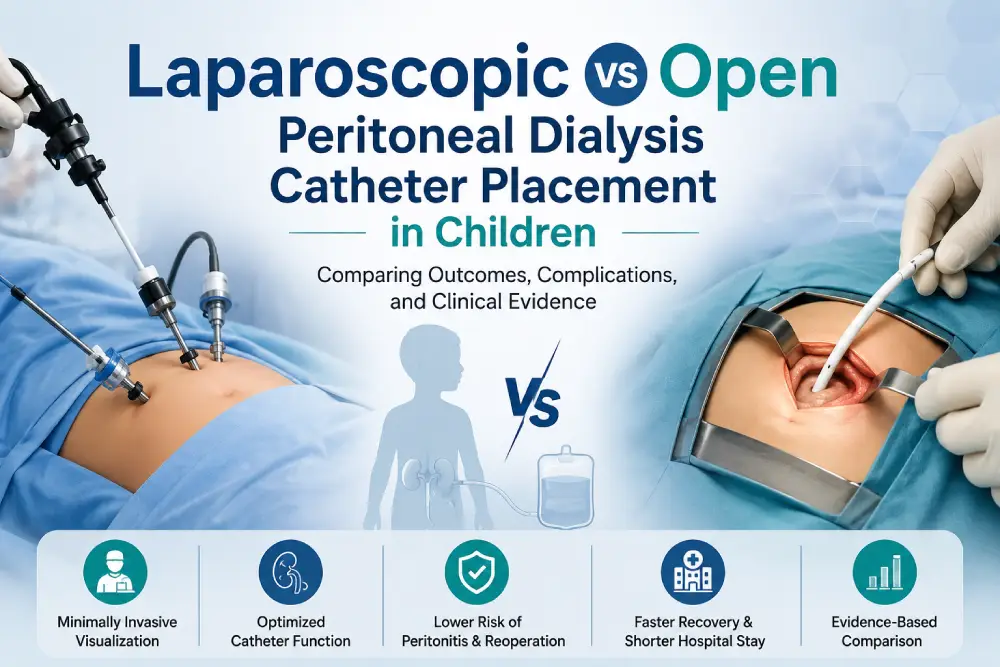
Peritoneal dialysis (PD) is an important renal replacement therapy for children with end-stage renal disease (ESRD). It can support home-based management, help preserve vascular access, and provide quality-of-life benefits. A key part of successful peritoneal dialysis is the proper placement and long-term function of the Tenckhoff catheter. However, complications such as peritonitis, catheter migration, obstruction, infection, leakage, and the need for reoperation can affect treatment outcomes. A recent systematic review and meta-analysis published in the Journal of Pediatric Surgery evaluated whether laparoscopic or open surgical placement of peritoneal dialysis catheters may offer better outcomes in pediatric patients.
What Does the Study Compare?
The study, titled “Laparoscopic Versus Open Insertion of Peritoneal Dialysis Catheters in Pediatric Patients: A Systematic Review and Meta-Analysis,” compared laparoscopic and open surgical techniques for Tenckhoff catheter placement in children undergoing peritoneal dialysis.
The researchers conducted a systematic review following PRISMA guidelines and searched PubMed, EMBASE, and the Cochrane database through May 2025. Studies involving patients under 18 years of age that directly compared laparoscopic and open catheter placement were considered for the analysis.
What Did the Meta-Analysis Include?
Nine observational studies involving a total of 659 pediatric patients were included. Of these, 288 children underwent laparoscopic catheter placement, while 371 underwent open surgery. All included studies were retrospective cohort studies, and no randomized controlled trials were identified.
The researchers evaluated several postoperative outcomes, including:
- Catheter migration
- Catheter obstruction
- Peritonitis
- Exit-site or tunnel infection
- Pericatheter leakage
- Need for reoperation
Laparoscopic vs Open PD Catheter Placement: Key Findings
The pooled analysis showed that laparoscopic placement was associated with a lower overall risk of postoperative adverse events compared with open surgery. The overall odds ratio was 0.55, with a 95% confidence interval of 0.33–0.90.
Lower Risk of Reoperation
One of the significant findings was the reduction in reoperation associated with
laparoscopic catheter placement. The analysis found an odds ratio of 0.28 (95% CI:
0.08–0.97; p = 0.0444), indicating lower odds of reoperation in the laparoscopic group.
Reoperations in the open surgery group were mainly associated with problems such as
catheter malfunction or malposition, omental wrapping, or hernia formation. Some
laparoscopic approaches also allow additional procedures, such as omentectomy and
closure of a patent processus vaginalis (PPV), during the same operation.
Lower Risk of Peritonitis
The meta-analysis also found a significantly lower risk of peritonitis among children
who underwent laparoscopic catheter placement. The reported odds ratio was 0.21 (95% CI:
0.09–0.52; p = 0.0006), with no observed heterogeneity for this outcome.
Peritonitis is an important complication in patients receiving peritoneal dialysis,
so this finding may have clinical relevance when considering catheter placement
techniques.
Outcomes Where No Significant Difference Was Found
The analysis did not identify statistically significant differences between laparoscopic and open techniques for several other outcomes. For catheter migration, the pooled analysis showed no significant difference between the two approaches. Similarly, no statistically significant difference was identified for catheter obstruction. The study also found no significant difference in exit-site or tunnel infections or pericatheter leakage between laparoscopic and open catheter placement. Therefore, while the findings favored laparoscopy for certain outcomes, the evidence did not demonstrate a definitive advantage across every measured complication.
Potential Advantages of Laparoscopic PD Catheter Placement
Laparoscopic surgery provides direct visualization of the peritoneal cavity. This can allow surgeons to position the catheter more precisely and perform additional procedures when required. The study discusses techniques such as rectus sheath tunneling, omentopexy, adhesiolysis, and other adjunctive procedures that may help optimize catheter function. The discussion also notes potential benefits associated with minimally invasive surgery, including smaller incisions, reduced postoperative pain, shorter hospital stays, and faster recovery. However, these potential benefits should be considered alongside individual patient factors and the available clinical evidence.
What Are the Limitations of the Evidence?
The findings should be interpreted with caution because all nine included studies were observational and retrospective. The researchers identified methodological concerns, including confounding, incomplete data reporting, differences in patient characteristics, and variations in surgical techniques. The study also notes that there were no randomized controlled trials and that operative techniques, catheter types, adjunct procedures, outcome definitions, and follow-up periods varied among the included studies. These limitations make it difficult to establish that one approach is universally superior for every pediatric patient.
What Does the Study Conclude?
The systematic review and meta-analysis found that laparoscopic Tenckhoff catheter placement was associated with significantly lower risks of reoperation and peritonitis compared with open surgery in the analyzed pediatric population. Based on the available evidence, the authors suggest that laparoscopic catheter placement may be considered the preferred initial approach when feasible, particularly in specialized centers with expertise in minimally invasive pediatric surgery. At the same time, the authors emphasize the need for future prospective studies with standardized surgical protocols to further validate these findings.
Download the Full Research Article
For readers and healthcare professionals who would like to review the complete research paper, the original article is available as a downloadable PDF.
Download Full Research Article PDF
This article provides a summary of findings from the published systematic review and meta-analysis. It is intended for informational and academic purposes and should not be considered a substitute for individualized medical advice or clinical decision-making.