Executive Summary & Background
Choledocholithiasis (common bile duct stones) in pediatric patients is a relatively rare clinical condition, yet its diagnosis and incidence have been rising steadily in recent years. If left untreated, gallstones in the common bile duct can trigger severe secondary complications such as obstructive jaundice, severe cholangitis, and acute gallstone pancreatitis.
The gold standard for treating concomitant gallbladder and common bile duct stones requires a combined surgical and endoscopic intervention: Laparoscopic Cholecystectomy (LC) to remove the diseased gallbladder and Endoscopic Retrograde Cholangiopancreatography (ERCP) with sphincterotomy to clear the common bile duct. However, the optimal sequencing of these procedures in pediatric surgery has long been a subject of ongoing debate.
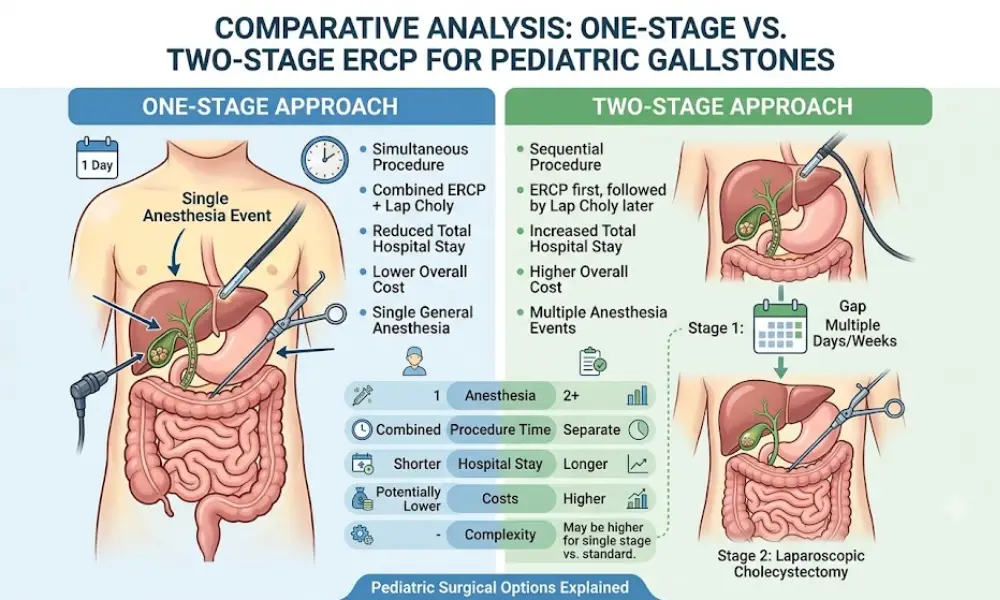
Currently, two primary clinical pathways exist:
- Two-Stage Strategy (Conventional Approach): The patient undergoes a initial ERCP to perform sphincterotomy and extract bile duct stones under general anesthesia. After a recovery interval, the patient is brought back for a second, separate surgical procedure to undergo laparoscopic cholecystectomy.
- One-Stage Strategy (Combined/Single-Session Approach): The patient undergoes both laparoscopic cholecystectomy and intraoperative ERCP sequentially within a single surgical session under a single administration of general anesthesia.
While extensive adult literature and meta-analyses strongly favor the single-stage approach due to reduced hospital visits and efficiency, pediatric-specific evidence has historically been fragmented, relying on small cohorts and single-center studies. To resolve this clinical uncertainty, this systematic review and meta-analysis quantitatively compares the safety, efficacy, and clinical outcomes of the one-stage versus two-stage management strategies exclusively in pediatric patients.
Methodology & Study Selection
This study was conducted following the PRISMA (Preferred Reporting Items for Systematic Reviews and Meta-Analyses) guidelines and registered on PROSPERO.
A comprehensive search was carried out across PubMed, Embase, and the Cochrane Library up to July 2025. The review evaluated studies meeting strict inclusion criteria:
- Population: Pediatric patients (≤ 18 years old) diagnosed with common bile duct stones/choledocholithiasis.
- Intervention (One-Stage): Concurrent LC and ERCP conducted under the same general anesthesia setting.
- Control (Two-Stage): Sequential ERCP and LC performed as distinct procedures during separate anesthesia events.
After screening 1,961 records and removing duplicates, three observational studies involving 165 pediatric patients met all inclusion criteria. Statistical pooled analyses were conducted using random-effects models in RevMan Web, reporting Risk Ratios (RR) for categorical outcomes and Mean Differences (MD) for continuous variables. Risk of bias was rigorously evaluated using the ROBINS-I tool for non-randomized studies.
Key Clinical Findings
1. Significant Reduction in Anesthesia Exposure
- Result: The pooled analysis demonstrated a statistically significant reduction in cumulative anesthesia time in favor of the single-stage group (Mean Difference: -25.23 minutes; 95% CI: -48.07 to -2.38; p = 0.03).
- Clinical Significance: Consolidating both procedures into a single anesthesia event eliminates the need for repeated intubation and duplicate anesthetic inductions. In pediatric healthcare, minimizing cumulative general anesthesia duration is crucial for mitigating potential respiratory risks and long-term neurocognitive impact.
2. Length of Hospital Stay (LOS)
- Result: The single-stage pathway demonstrated a trend toward shorter overall hospital stays (Mean Difference: -0.71 days; 95% CI: -1.69 to 0.26; p = 0.15).
- Clinical Significance: Although statistical significance was subject to study-level variability in sensitivity analyses, single-session management avoids prolonged interval admissions between duct clearance and gallbladder removal.
3. Overall Postoperative Complications
- Result: No significant differences were observed in overall complication rates between the single-stage and two-stage cohorts (Risk Ratio: 0.77; 95% CI: 0.30 to 1.94; p = 0.58; I2 = 0%).
- Clinical Significance: Single-stage procedural consolidation achieves efficiency without compromising safety or elevating risks of post-ERCP pancreatitis, surgical site infection, or bleeding.
4. Hospital Readmission & Interval Complications
- Result: Readmission rates were low and statistically comparable (Risk Ratio: 0.59; 95% CI: 0.12 to 3.05; p = 0.53).
- Clinical Significance: In two-stage care, patients remain at risk during the interval delay between ERCP and delayed cholecystectomy. Several cases in two-stage groups developed recurrent biliary symptoms, interval acute cholecystitis, or cholangitis while waiting for their secondary surgery. One-stage treatment completely eliminates this interval risk window.
Health Systems & Economic Considerations
Beyond direct patient outcomes, healthcare utilization strongly favors single-stage management:
- Cost Savings: Combining interventions reduces duplicate hospital admissions, duplicate operating room setups, and repeated perioperative care charges. In literature cited within the meta-analysis, single-stage care demonstrated substantial savings per patient (e.g., hospital costs of $45,597 in the one-stage group vs. $61,008 in the two-stage group).
- Resource Logistics: The primary barrier to implementing single-stage interventions is institutional logistics. It requires multidisciplinary coordination between advanced pediatric gastroenterologists/endoscopists, pediatric surgeons, and operating room staff to align schedules.
Conclusions
This meta-analysis concludes that for pediatric patients with choledocholithiasis, a single-stage strategy—combining laparoscopic cholecystectomy and ERCP under a single anesthetic session—is safe, effective, and efficient. It significantly reduces cumulative anesthesia exposure while offering comparable complication and readmission rates to the traditional multi-stage pathway.
Read More
Download the full research PDF paper
About the Author
Dr. Ashwin Pimpalwar, MD, FRCS, is a highly specialized Pediatric Surgeon based in Richmond, Virginia. Serving as the Chief of Pediatric Surgery, Dr. Pimpalwar brings more than 30 years of international surgical experience, with expertise in minimally invasive pediatric surgery, robotic-assisted procedures, bowel motility programs, and the management of complex gastrointestinal disorders in children.